Mostrando postagens com marcador Interviews. Mostrar todas as postagens

25/07/2009

A brilliant artist from cover to cover: an interview with Brian Bolland, part3.


Last part of our exclusive interview, and Brian Bolland talks about drawing DC super-heroes, the fantastic Animal Man and The Invisibles covers, his personal projects, funny strips, gorgeous women and a lot more.

Wellington Srbek: Nobody draws DC characters better than you! Your detailed style with classic lines and bright colors gives them volume, weight, personality and life. It has something of the “Silver Age” and at the same time is completely modern. Do you have a conceptual approach to how super-heroes should look like?

Brian Bolland: Well, I grew up as a Silver Age fan and certain artists from that era were my idols. Gil Kane, Carmine Infantino, Alex Toth, Bruno Premiani. I never got into Jack Kirby I'm afraid. I was more a fan of the artists than of the characters and keener on the comics as collectable artifacts than of the stories. I seriously wanted to draw like Neal Adams but never managed it. I'm a stickler for art that's technically and anatomically well drawn but I realize there has to be much more than that. I don't think I'm particularly good at super-heroes. My work looks rather European in that I'm happier with characters that are still, poised or frozen in time rather than the kinetic action that's required from American super-hero comics. I do get asked occasionally to re-create a Silver-age cover and draw in the style of Premiani, Kane or Curt Swan. (They're more swipes really!) I do love the cleanness and the unclutteredness of the 60s covers.

WS: I simply love your Animal Man covers! They are powerful and meaningful images that add a lot to the stories. The #5 cover for instance is a masterpiece! How was the creative process on that series? Did you read the scripts and come up with the concepts for the covers?

BB: Thanks. I much prefer story-specific covers as opposed to the generic poster shot. I despair when and editor says "just do an action shot." I reply "Yes, but what exactly is it they're doing?!" I always thought 2000 AD had a mixture of action, horror and comedy that worked very well and I wasn't seeing quite that combination in American comics at the time. I'm happy with that combination and the Animal Man covers allowed me to do that. If I remember correctly I usually had a script to read for the covers. I went along and put stars on the pages of script where something was happening that I thought would make a cover. Quite often I was coming up with ideas that meant something to me that probably wouldn't have been noticed. Cover #39 for instance is my homage to the cover of House of Mystery #1 from 1951. #45 is a spoof or a re-cycling of the cover of the Eagle Judge Dredd #1. My absolute favorite is Animal Man #25.

WS: Your covers to The Invisibles series are aesthetically and technically different from your Animal Man covers. What were the main challenges working on that complex Grant Morrison’s series?

BB: The first challenge was the fact that the scripts weren't available. Soon I actually liked that and the covers took on a life of their own. They were a combination of what editor Shelly Roeberg wanted, what Grant wanted (when she could get him on the phone) and whatever idea popped into my mind. The last 12 were just me letting my mind run free. Especially the final trade paperback covers. I could analyse each cover and point out all the secrets hidden in them but it would take a whole book.

WS: Your artwork is well known for the detailed drawings, the beautiful black & white contrasts and textures, the intense facial expressions, the strong compositions and so on… What has changed on your creative process now that you don’t produce “real artwork” on paper anymore?

BB: The only thing that's changed is technical. The computer is just a means of achieving what I would have wanted anyway. I'm extremely happy to leave behind all the treacherous tools like brushes, pens, airbrushes and all the paints, inks and acrylics. All of which had to be washed. Now I can pencil and ink without any problems and I have some extra perks like tracing occasionally. Photo-collage when I want it.

WS: Besides amazing super-heroes, you also draw the most gorgeous women and some very funny strips. But this is a side of your work that is less known, so please tell your Brazilian fans something about The Actress & The Bishop and Mr. Marmoulian.

BB: Mr. Mamoulian came as a reaction to the time I was spending on my drawings and my obsession about drawing well. My slow speed was preventing ideas tumbling out at a quicker rate. So I decided I'd draw a page in two hours and the title character came from the first page I drew. But it took on a life of its own and now I spend longer drawing it. My only concession is that I only draw it when I feel like it. The Actress & the Bishop grew from a single plate I did in my portfolio for French publishers Editions Deesse. I wanted to write it and draw it as well as I could. It had a particular Englishness about it and to counter the fact that people might think from its title that it would be pornographic or something I thought I'd write it like a nursery rhyme. I was very keen on the films of Peter Greenaway. They had in them obsessions about numbers and counting and things like that. The rhyming in the Actress & the Bishop was a way of giving myself an obsessive structure.

WS: You are now producing covers to the new Animal Man 6-part mini-series. I just loved #1 cover! After this, what are your future projects?

BB: More traveling. I'm working on a book of photos of a week spent in Burma back in 1988. Did I already mention that? I'm doing a new Actress & the Bishop story. Continuing Jack of Fables covers as long as they'll have me! Other projects bubble away but who knows of I'll get round to doing them.

WS: Thanks very much for this interview, Mr. Bolland! And thanks for the brilliant and beautiful work!

BB: Thanks to you.

21/07/2009

A brilliant artist from cover to cover: an interview with Brian Bolland, part2.


Part2 of our exclusive interview, and Brian Bolland talks about the comics masterpiece The Killing Joke, how it was to work with Alan Moore on this groundbreaking graphic novel, and also “grim & gritty” comics and editorial censorship.

Wellington Srbek: The original idea for a Batman and Joker special story was yours, and it was also you who suggested the name of Alan Moore as the writer for what came to be The Killing Joke. So, how it was to work with Mr. Moore on this groundbreaking graphic novel?

Brian Bolland: The first half of your question is correct. After Camelot I was in a position to do whatever I wanted for DC. Alan Moore, Kevin O'Neill, Dave Gibbons, Mick McMahon, etc. were all friends from the 2000 AD days. Alan and I had a couple of projects that we nearly worked on together, one of which was a Batman / Judge Dredd book. So I'd already seen parts of a script by him containing Batman. Alan and Dave had just had a big hit with Watchmen. I was fascinated by the Joker. I'd seen the 1920s film The Man Who Laughs from which, they say, Jerry Robinson got the idea. Alan asked me what sort of thing I wanted to draw.
Back in those days (and still today for me, actually) the business of writing comics and drawing comics were completely separate. The writer sat at home writing. The script was sent to the artist who would draw it - and neither would interfere with the other's process. That's the way it was with The Killing Joke. So if you ask "how was it to work with Alan?" my answer is: I asked Alan to write it. He wrote it. I drew it.

WS: The Killing Joke was a Batman comic like no other before. It was the Joker origin story told for the first time. It was realistically violent and insane, and it was in part responsible for the “grim & gritty” trend that dominated super-hero comics in the late 80s early 90s. But despite all the violence and terrible scenes, The Killing Joke has the most beautiful and detailed Batman artwork. What are your feelings about this amazing book?

BB: When the script came it did contain things that I wouldn't have had in it if I'd written it. I personally would never have told a Joker origin for instance. But looking at it later I can now see that the bits I wouldn't have included look pretty iconic today. I sometimes think that us artists from Britain who'd been in 2000 AD brought the "Grim & Gritty" with us when we went to work for DC.

WS: The first Brazilian edition of Camelot 3000 had a Tristan and Isolde scene censored by the editors here. And it seems that the DC editors did something like that to one of The Killing Joke pages, replacing (or asking you to replace) the naked breasts of Barbara Gordon by a close-up of her face. Have you ever had any problems with editorial censorship?

BB: I've never had PROBLEMS with editorial censorship. Somebody at DC must have mentioned that Barbara Gordon scene. I changed the one panel and I thought it improved it. I'm aware of all kinds of things you can't put on a cover. Nudity is out. I once drew a Robin cover that had some Greek statues in the background that I copied from photos. Between them the statues had five visible nipples. All were whited out! I once drew a Batman cover that had Batman smoking a cigar. Well, it was Hugo Strange with beard, dressed as Batman smoking a cigar. I couldn't do it. Maybe they rejected it in favor of another idea but I assume there are various unwritten rules that you can't cross and Batman cannot be seen smoking. And there are legal issues. I once drew a Batman cover that had what appeared to be a member of the Ku Klux Klan sitting on a horse. We had to add a logo on his chest to show that he belonged to some other white supremacist organization because the Ku Klux Klan have lawyers who might sue!
In August 2009 I'm off to a convention in Singapore. For the occasion we're printing a book containing some of my penciled prelim roughs. It turns out, unfortunately, that quite a few of the drawings, including my favorite Tank Girl roughs, can't be included because of the very conservative stance of the authorities in that country. I assume my books Bolland Strips! and The Art of Brian Bolland won't be on sale there for the same reason.

WS: After giving us the definitive Joker in The Killing Joke, we haven’t seen many stories drawn by you. What are the reasons for this?

BB: Well, after The Killing Joke, I had a lot of work offered to me. I had to turn much of it down but people would say "Could you just do the cover." Doing covers meant that, just that one time, I could draw a whole lot of characters that I wouldn't otherwise draw. In summer 1988 I went off on what I thought would be a long trip round the Far East so I wasn't able to commit to long term work. Also, Having worked with the best writer and having been given as much time as I wanted to pencil and ink myself I didn't want to take a backward step. Since Alan I haven't drawn a significant story by any other writer. Except for ME. I did write and draw "An Innocent guy" in Batman Black & White, "The Kapas" in Strange Adventures and "The Princess & the Frog" in (was it called?) True Romance. Also Mr. Mamoulian and The Actress & the Bishop. But more on that later.

Next: Animal Man, The Invisibles, beautiful covers, funny strips, gorgeous women, and a lot more!

17/07/2009

A brilliant artist from cover to cover: an interview with Brian Bolland, part1.


I will buy a comic book just because it has a Brian Bolland’s cover. Really! (I’ve just done that with this new Animal Man series.) Since I first saw his work on The Killing Joke I’ve become a fan. After that came his amazing covers to Animal Man and other works that assured him a place in my personal comic book Olympus. In this 3-part interview, Mr. Bolland talks about his early works, the Judge Dredd stories, Camelot 3000, his fantastic covers for DC and more. Enjoy!

Wellington Srbek: It’s a real honor to be talking to you, Mr. Bolland. Let’s begin with a biographical question: where and when you were born, and how the art of comics entered your life?

Brian Bolland: First of all a plug for my book The Art of Brian Bolland in which I've answered that question in about as thorough and lengthy a way as I possibly could. So, to summarize: Born March 26th 1951. I have the same birthday as esteemed artist José Luis García-Lopez and biologist and atheist Professor Richard Dawkins. Near the English town of Boston. That's the original Boston by the way. American comics started being imported into Britain in 1959. I first took an interest in them in 1960/61 when I was 10. I started drawing my own childish versions of these round about that time.

WS: You have a background in Arts and graphic design, but at the same time your comic book pages and covers display a profound understand and a true love for this art form. Which comic book artists most influenced your view and your style?

BB: I spent 5 years in various art schools. Comics hadn't penetrated into the art school world. I spent that time studying the whole of modern and contemporary art. Some of it I liked. Some of it I didn't. I was never very keen on the Impressionists. I liked Salvador Dali and René Magritte while still at school. I was impressed by Ingres.

WS: I’ve got here a couple of American reprints of the Powerman strip you, Dave Gibbons and others produced for the Nigerian market. I believe that that was your first paid job with comics and also an opportunity to learn the craft, is that right?

BB: That's correct!

WS: Then came the Judge Dredd stories and the covers to 2000 AD, which made people really pay attention to your work. How did you get the job, and how it was to work on 2000 AD?

BB: Way back in the second half of the 1960s there were comics fanzines. People like Dave Gibbons and my friend from near where I lived, Dave Harwood, were active in all that. In 1972 quite a few of us met up at a comic convention in the Waverley Hotel in London. In 1977 one of my friends from fandom, Nick Landau, was working as the editor on 2000 AD and he asked me to draw a Judge Dredd story to replace an artist who had dropped out. I had the same artists' agent as Dave Gibbons - the one who got Dave and me the job on Powerman. He had already fixed me up with cover work on 2000 AD. I loved working on 2000 AD. All the people involved were enthusiastic about this new hit character. The stories were great - and funny. We were very impressed by Mick McMahon's work. Unfortunately the company who owned 2000 AD wasn't treating its freelance artists very well.

WS: I believe that you were the first British artist to work for the American market in what is usually called “the British invasion”. Please tell your Brazilian fans how that came to be.

BB: Another of my friends from the fanzine world was Richard Burton. (Not the actor!) He knew Paul Levitts, another ex-fanzine person from New York. Paul used to put out The Comic Reader. Now he was something important at DC Comics. In 1979 Richard heard from Paul that US artist Joe Staton would be staying in London for a convention but would need a table to work on while he was here. He was drawing Green Lantern at the time. Joe and his wife Hilarie turned up and I watched him draw on my wife's drawing table which she wasn't using at the time. When Joe heard I'd been a Green Lantern fan since I was 10 he phoned up Jack C. Harris, his editor, and said he was in the flat of this English artist and how about letting him draw the cover on the current issue. It was a risky move on Jack's part. He probably saw my work on Judge Dredd which had only been seen by a few enthusiasts in the US. At the time, before fax machines or e-mail or computers, it seemed difficult to work across the Atlantic Ocean so it was a few years before we worked out the logistics of things.

WS: Camelot 3000 was your first major work for DC, and it is also your biggest work in terms of length. What can you tell us about this 12-part series / graphic novel?

BB: Well, regular work didn't come for me from DC right away. It took them a little while to work out what to do with me. Then editor Len Wein and Writer Mike Barr pitched the idea of Camelot 3000. I was chosen to draw it. I was whisked off on the publicity bandwagon to the San Diego Comic Convention and places. I'd never been treated so well before. It was American comics' first prestige "maxi-series" printed on better than usual paper I think.

Next: The Killing Joke!

08/12/2008

The art of coherence: an interview with Dave Gibbons, part3.


Last part of our interview and Dave Gibbons talks a little bit more about Watchmen, tells us about his new book, says what he thinks of the movie adaptation and also which are his new and future projects.

Wellington Srbek: I use the analogy of Watchmen being similar to a Swiss watch: a construct of hundreds and hundreds of tiny pieces that come together to form a working machinery. There’s also the analogy of Watchmen being similar to a symphony: a complex structure, composed by various movements with lots of echoes and symmetries. Both analogies give the idea of “a whole that is more than the sum of its parts”. But for you, Mr. Gibbons, what Watchmen represents?

Dave Gibbons: Yeah, I think, you know, even within the book we have made analogies to clockwork -- the form of Doctor Manhattan’s palace is like the internal works of a clock. That said, I’ve always considered Alan’s approach to writing to be a little bit like kind of Mozart’s approach to music, you know, he sees the whole thing in his head, he has the whole symphony in his head with all the parts, he writes down in great detail. And then, as an artist, you essentially interpret that, you essentially are the orchestra, you are the conductor. And so… Yeah, I think that’s a very good analogy, and I think I kind go along with that been what Watchmen represents to me, you know, any writing thing, any joint thing, always happens piece by piece, and it’s not really until be done the whole thing that you can sit back and see, see the landscape. So, ahn… Yeah! Is a symphony, is a clockwork.

WS: You’ve just released Watching the Watchmen: The Definitive Companion to the Ultimate Graphic Novel. Please, tell us about this book.

DG: Well, as I said it is published by Titan Books, it is 257 pages, it’s got loads of sketches, the real thumbnails for the whole series, it’s got pages of Alan’s script, it’s got letters between us, it’s got letters for DC, it’s got pictures of the merchandize, it’s got unpublished pages, it’s got designs that we never used, it’s got schematics and plans, and it’s also got a commentary by me -- ah, my story of how Watchmen came to be, from its very, very beginning. Ahn, it’s also got a very interesting essay by John Higgins about how he colored it. And it is solely about the comic book, it doesn’t make any mention of… ah… the movie or anything to do with that. I wanted it to be a celebration of, you know, the creative experience Alan and I had, which was a very positive and enjoyable creative experience. It doesn’t strands in the areas of the… ah… contention or disputes between Alan and DC Comics, because it is not that kind of book -- you know, that might well appear in the future, it is another book. Really, it is a very detailed, very dense celebration of what it was like to create Watchmen.

WS: A friend brought me from the USA your promotional poster to the Watchmen movie. So, I believe that you are happy with this adaptation of the book. What are your expectations about the movie?

DG: Yeah, I’m happy with the adaptation. From the very beginning, from my very first conversation with Zack Snyder I had a good felling about it. And certainly every additional thing that I’ve seen has only made me feel better. I saw half-cut of the movie back in August, which I totally enjoyed -- wasn’t finished, a lot of the CGI wasn’t done but it was absolutely engrossing and fascinating. Since then I’ve seen… ah… both the trailers, and I’ve seen the 25 minutes or so of scenes that Zack has shown to journalists, and I’m taking part in the Watchmen road show, and… Yeah, I feel that it’s been done properly, it’s been done as well as anybody could reasonably expect. Ahn, and… I’m very much looking forward to seeing it out there in the cinemas, and gain everybody’s reaction to it. I have a feeling that the fans are gonna be very happy with it. Of course there are those absolute diehard heart fans -- I understand that -- for whom nothing but actually word for word, picture for picture, line for line adaptation would ever do. I think you have to be a little bit more realistic about it. In the end of the day, I think you have to have something which is a good film, something that the average movie goer will consider worth going to see.

WS: Recently you have finished the Martha Washington saga written by Frank Miller, besides written and drawn some Green Lantern Corps issues. What are your plans for 2009 and the near future?

DG: Well, on the section of Martha Washington we are gonna collect all together into one big oversized book, it will be 500 pages plus, and it will be absolute size, and it will have new introductions by Frank and by me, and it will have hopefully every possible appearance of Martha. Because her appearances have been relevant scatterly, we wanna bring it all together so that readers could read it all in one place. I’ve recently done a little Hellblazer story for DC, which I wrote -- character that I strangely enjoy. Ahn… Really now my time is taken on the Watchmen promotion, and licensing, consultancy. Ahn, I hope to be working on a creator owned project next year with a writer that I haven’t worked with before -- can’t really say any more than that, because obviously it is not just up to me how this is announced. But, yeah, I’m very much enjoying the Watchmen road show circus, and looking forward to the movie coming out, and sometime after that going back to do some honest work.

WS: Thanks a lot for this interview, Mr. Gibbons!

DG: Thanks very much for your interest, and greetings to my fans and friends out there in South-America!

03/12/2008

The art of coherence: an interview with Dave Gibbons, part2.


Part2 of our exclusive interview and Dave Gibbons explains how the masterpiece Watchmen was born, what was his approach to Alan Moore’s massive script, and also his main challenges creating such a length and coherent artwork.

Wellington Srbek: “Chronocops” for 2000 AD and “For the man who has everything” for the 1985 Superman Annual are two of my favorite Moore/Gibbons collaborations...

Dave Gibbons: Mine too.

WS: Nevertheless, nothing can be compared to your masterpiece Watchmen. It was a “quantum leap” in the quality and complexity of the work you were doing then. How and when the project was born?

DG: Is kind of a long story. I have actually written a book called Watching the Watchmen -- which is published by Titan, which I don’t know if has any plans for a Brazilian edition, although that tells you the complete story. Alan and I met in a convention in 1980, over the following years we become friends, and we worked on shorter stories for 2000 AD together, which have culminated in “Chronocops”. Ahn… We really wanted to do something longer together, which was why we wrote the proposals for the Challengers of the Unknown and Martian Manhunter for DC, but none of this ever came to fruition, because the characters have already been promised to other writers and artists. So, you know, when we got the chance of work on something bigger, we jumped at it. And Alan has always been happy to tell people the stories he was working on before he has even started. He tends to work things up in great detail before had -- he used tell me about things he was working with other people. But I actually learned about Watchmen from a mutual friend, a guy called Mike Collins -- to the best of my memory -- ah, who said: “Oh, have you heard that Alan is working on a thing that is gonna treat the Charlton characters for DC?” I immediately phoned Alan, and he sent me the synopses, and I really liked it, said I would like to draw it, and he said: “Great!” A couple weeks after that I went to the USA, and on a convention I met up with Dick Giordano, who was the managing editor of DC, and I said: “You know this thing Alan is doing with the Charlton characters, I really want to draw it.” And Dick said: “How does Alan feel about that?” And I said: “He wants me to draw it.” And Dick said: “It’s yours!” So, that was really how the project was born.

WS: Looking at the script pages in the end of the Absolute Edition, it seems to me that you’ve developed a system to work with Alan Moore, marking his text with different colors -- yellow for the main visual information, red for details and blue for the dialog. Anyway, what was your approach to the Watchmen script?

DG: Well, Alan’s scripts are always very wordy, very conversational, very much giving you options, very much talking around the subject, and, you know, giving you probably more information than you can ever actually use. So, one of the things you have to do is to take control of the script, and take from it what you need to draw it the way you see it. So, I found a highlighting was a very good way to do that. And also after a couple of readings I wanna do some thumbnail drawings, which meant by then I could transfer those to the finished art board, and I could letter in the dialog. And I was sufficient familiar with the story by then, I probably didn’t have to look at the script again, I didn’t have to read three dozens of pages to find out what I had to draw. So, yeah, in many ways my part was one of selection.

WS: Watchmen is a complex realistic super-hero comic book, a award-winning work that many people consider to be the best graphic novel ever created. My question is: what was your main challenge creating the book?

DG: Ahn… Well, I suppose it is the challenge, as a comic book artist, you always have, that is to tell the story in pictures. And in this case it was a very detailed, very complex, very rich story, with lots of nuance, and requiring characters to be draw in different ages, in different locals. So, it really tested my drawing skills, and my ability to pick characters consistently believable, my background symmetry, dimension of real. And really, you know, just an exaggerated version of what the challenges will be on any other book.

WS: Reading Watchmen cover to cover we have this feeling of a complete 360° reality. You are of course a very skilled artist, but it’s amazing how the 400 pages plus of the book have always this coherent look, with the moody colors by John Higgins. How did you manage to achieve that coherence in such length work?

DG: Well, again is like the answer to the last question. Really what drawing comics is about is achieving coherence, making things consistent, and never pulling the reader out of the story by drawing something that doesn’t fit. I mean, I did… Again, in my book Watching the Watchmen you can see diagrams, plans, schematics of things like the perfume bottle falling through the air -- after Lauren has thrown it on Mars -- to make sure that the movement was consistent, and that it moved believably against the fix background of stars. Probably not a work that anybody will notice, but nevertheless something that in a subliminal level it does give that feeling of somewhere that actually exists or something actually happened. There was a British comics called Dan Dare -- science-fiction strip -- where they actually had the time and the budget to build models and everything, and when you read that you really felt that you were seeing something drawn from life, you know these incredible things had been drawn from life. And although I drew Watchmen in a stylized way I wanted it to have that internally consistent feeling. And, you know, when you are drawing comics you are translating reality into code anyway, and to my way of thinking the best comic artists are people like Jack Kirby or Steve Ditko, who clearly don’t draw realistically, but who have a consistent code for interpreting reality. So, that is the kind of thing I tried to do when I drew Watchmen. And, as you say, John Higgins’ colors are amazing, and certainly he had a great trouble to keep those consistent, and very much relate to what was going on in the book… in the story rather. Sometimes, you know, he had already colored something, before he realized it had to be colored in a different way. But fortunately with the Absolute Edition he was able to address those concerns, and make the coloring finally completely consistent.

Next: clockwork, symphonies, movies and more...

27/11/2008

The art of coherence: an interview with Dave Gibbons, part1.


Dave Gibbons is one of the most important British comic book authors of all time. Among various works, he was the artist of Watchmen, the 12-part series written by Alan Moore, which many readers consider the best graphic novel ever created. In this 3-part exclusive interview done by e-mail and MP3, Mr. Gibbons talks about some of his early works, the creation of the masterpiece Watchmen, what he thinks of the movie adaptation, his new book, future projects and more.

Wellington Srbek: It is an honor to be talking to you, Mr. Gibbons.

Dave Gibbons: Thank you! Honor to be talking to you.

WS: Please tell your fans when and where you were born, and how comics entered your life?

DG: Ahn… I was born in London. I was born in 1949, long, long time ago now -- longer than I really like to think about. And how comics entered my life? Well, I guess as a little kid I used to get kind of nursery comics, you know, familiar animals, and rabbits, and bears, and all that kind of stuff. And I also got a British comic called The Beano which is still go in need today, it’s been on since the 1930s -- is the one comic that all British people think about if you say the word “comics”. Ahn… I also got a very clear memory been about seven years old and been bought my first Superman comics by my granddad… ahn… and I think from the minute I saw that I was lost to comics.

WS: You began your carrier working on horror and action strips, but it was on the science-fiction magazines 2000 AD and Doctor Who that you could develop your artwork. The first American comics you drew -- the Green Lantern Corps stories -- also had something to do with SF. So, do you have a special fondness for that specific genre?

DG: Well, I do. I’ve always been the science-fiction reader most of my life. I’ve not read lots of science-fiction lately -- I think you can only read the words hyperdrive or teleportation so many times. I moved on to crime and non-fiction, and everything. I still have got love for science-fiction, and I think with comics it works particularly well. You can do anything in the comics, so why do something that is complete everyday? It’s important to be able to draw things so they look believable. So to be browned in during the everyday actually is a really good thing. Ah… But I think when you wanna to explore the possibilities of the medium a bit more, you almost inevitably journey towards things which are larger than life. And science-fiction, you know, is certainly that.

WS: You’ve become internationally famous working on American superhero comics, but you had previously worked on an African superhero strip: Powerman. It was kind of a black Superman, published in Nigeria, right? Give us an idea of what that strip was.

DG: I used to work through an art agent in London. He was approached by a Nigerian advertising agency, with the idea of producing some comics for the Nigerian market. Up to then, Nigeria tads of British and American comics most of which featured, you know, blonde white people, and they just thought it was a good idea -- I imagine from the merchandising and advertising point of view it was really a good idea -- to give black people their own heroes. We were amazed that they didn’t have people in Nigeria who could draw and write comics, but they said, you know, possibly for we took the lead and eventually, you know, indigenous creators would take over. Ahn… So, there were a couple of comics: one called Powerman, one called Pop. Powerman featured Powerman, and also a sheriff, a black sheriff, a fried slave in the Wild West, and an alien invasion story where the aliens invaded Africa, rather than North-America. There was another one called Pop, which was featured a black nurse, and a couple of other ideas which a really can’t remember that. They were written by standard British comic writers and drawn by myself, Brian Bolland, Carlos Ezquerra -- who went on to draw Judge Dredd -- and it was a biweekly comic, black and white with one color added -- red. Brian Bolland and I did alternate issues with I once in a while had to help Brian out when he fell behind deadline. They were latterly printed in South-Africa with the rather unfortunate fact that there appear to be “Apartheid comics", you know, white people had their comics, and black people had their comics. But that was never the idea with the originals, and it felt that any white person that we ever featured was an awful Arian blonde property developed crew post-Blitzer who Powerman dispatched in short order.

WS: You were part of the “British invasion” that changed American comics in the 80s, following Alan Moore’s work on Swamp Thing. At that moment, did you feel that you were bringing a revolution to American comics, and producing works that would become classics?

DG: I suppose there was a kind of British invasion, it really started with Barry Smith back in the early 70s. He was the first British guy that I’m aware of to have worked for American comics. From Barry Smith I think Brian Bolland was the next Briti to be published, he did some Green Lantern covers back in the late 70s. Ahn… I actually started to work with DC before Alan, and we were trying to get things going for DC when I was phoned up one night… ahn… by Len Wein, he asked me if I had Alan Moore’s phone number, because he thought he could, you know, make a good attempt writing Swamp Thing, and as we all know Alan made not a “good attempt”, he completely revolutionize it until indeed come up with a classic. Ahn… I suppose, you know, it was an ambition of us Britis who have grown up reading American comics to one day work in American comics, and giving that that business were much better -- they paid more, they gave all the work back, they even gave the board to draw on -- it wasn’t surprising that we were very happy to be working for them. And I think, you know, we understood their characters well enough that we could draw in a similar style, but we have a slightly detached… ah… British view of them. And British kind of attitude is always to be slightly doubtful of people who are superior, maybe we brought a little bit of that to the superheroes. Although, it must be said unless we really loved the characters I don’t think we could have done what we did with them.

Next: Watchmen!

28/05/2008

A Monstrous Talent: an interview with Steve Bissette, part5.


To finish, Steve Bissette speaks about a new book on Neil Gaiman's works and also his plans for the future.

Wellington Srbek: It seems to me that your dearest creation, your “pet” project is Tyrant, a comic book series about the life and death of a Tyrannosaurus Rex. You have put lots of love and research in that one, haven’t you?

Steve Bissette: Yes, sure did. I loved doing it, and I'm still mighty proud of what was completed. I hope to return to it one day, though I'll never again be at the creative peak I was at in 1994-97 when I was doing Tyrant. Such is life.

WS: Your last work for a mainstream publisher was the Swamp Thing-related “Jack in the Green” short story, written by Neil Gaiman and inked by John Totleben. I think you have partially answered this question already, but please explain to us why you had announced your retirement from the comics industry after that work in 1999.
.
SB: Well, the long answer is already online -- go to: http://albert.nickerson.tripod.com/creatorsbillofrightsbist8.html.
Some of that reiterates the whole 1963 debacle, which I've just articulated anew for you above, Wellington; forgive the redundancies, please.
Since that all emerged from my old friend Dave Sim challenging me, note that Dave Sim's response is buried here (scroll down a ways, it's there): http://groups.yahoo.com/group/cerebus/message/103644.
Beyond that, there's also some follow-up on http://www.creatorsrights.com/. Go to: Creators Rights Forum Index -> Creator's Rights Discussions on the discussion board. And then: the thread entitled: "Post subject: Steve Bissette's letter: Dave Sim and 1963..." -- my letter, and Dave's reply, are there complete, followed by some conversation about relevant issues.
The last straw for me in 1999 was the realization comics was a dead end professionally. I won't go into the particulars, beyond the larger issues addressed in my letter to Dave Sim. It's not important any longer.
To touch upon a key point in my letter to Dave Sim, linked above, I'd arrived at a point in life I saw my teachers at the Kubert School reach in their late 40s. As a result of seeing my own situation as a life cycle issue in part, I didn't take it personally, but it was clearly time to leave the room for good.
My farewell signature at the end of "Jack-in-the-Green" really was my farewell. I'd had it with the comics industry, and nobody cared I was leaving, really. Neil's script summed up all my feelings about the community I'd once been part of: the village was ravaged with plague and there was nothing left to 'live for' there. Torch it. So, I did -- I torched it, via the story, and I left. That last page spoke volumes for me, there was and would be no better grace note to depart with.

WS: In the last decade, you have worked as a teacher and also written short stories, essays and critics. There’s for instance a new book on Neil Gaiman’s works to be published later this year. But you are also preparing a comeback to the comics medium, right? Something involving Tyrant and the 1963 characters you own. What can you tell us about that?

SB: Ah, let's see what happens. I have plans and hopes and dreams, like anyone, but as the old joke goes, "How do you make God laugh? Make a plan." We'll see what really comes to fruition in time.
I'm DONE in the American comics industry. That's over. Nothing has changed there in the years since I announced my retirement in 1999, except for the worse. Don't bother looking for me there.
But that hardly means I've been unproductive. I'm drawing some new comics for publication these days, and enjoying it. I'm being selective about doing it pretty much exclusively for venues supporting younger cartoonists -- the Accent UK Zombies anthology, Trees & Hills (a local New England coalition of cartoonists), and CCS or CCS-related projects, like Sundays, Dead Man's Hand and the upcoming Secrets & Lies. I do it only if I'm invited. That's worthwhile to me just now; there's no money in any of it, so fuck it, I do it for love only, in part to support the new generation's efforts.
Any fantasies you may harbor that existing publishers want my work can be easily remedied by the hard reality of the situation. I've had plenty of fruitless, time-wasting tangos, from a year of dancing with the late Byron Preiss over an aborted trio of Swamp Thing novels (Byron would not negotiate the contract, and then refused to pay the advance) to the various 1963 reprint ventures, including two overtures from Image and a rather hilarious exchange with DC Comics. As I've noted on my blog in the past, the only offers I've fielded in the past seven years in comics were from publishers fishing for free Bissette work. That, I can do myself, thank you; I've published, co-published, and self-published. If there's no money in it, I'm quite capable of doing everything myself, thanks, and choose not to, especially in the current market.
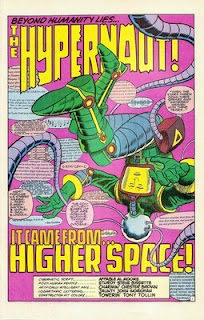
Let's see, there's other things: I've done some illustrations for friends's book projects and magazine articles, and I wrote a book-length essay for Rick Veitch that may see print later this year. There's a t-shirt company that's licensing my art, which is cool, and a cell phone game of The Fury was licensed in 2007; I've got my own projects with The Fury, N-Man and Hypernaut underway, and posted some new material on those on my blog. If it's fun and personally satisfying, I'll do it; otherwise, life is too short.
I occasionally get to dabble with the wedding of comics and cinema, which I enjoy. My son Daniel and I drew up a dummy Christian comic tract for my friend Lance Weiler's Head Trauma (2007), and that was great fun; Lance involved me creatively in the process, and we crafted individual panels and pages to resonate with the film after Lance showed me the rough edit of the film, which was a very satisfying collaborative venture. I subsequently packaged a "Jersey Devil" mini-comic for the DVD re-release of Lance Weiler and Stefan Avalos's seminal digital feature The Last Broadcast, working with some of the pioneer students at CCS. I'm presently working with a couple of filmmakers on short film adaptations of some of my own comics stories; I can't say much about that now, except to note I've seen the rough edit on the first short film, and that's fun for me, too. There's no money in any of this, either, which is fine -- I retain legal rights to my properties, and co-own the films with the filmmakers, so it's all good. As long as it's pleasurable, I pursue it.
I've got a few irons in the fire with the book industry; the grass isn't any greener there, I've no illusions about that, but it is where comics have gone and where my passion as a writer is most relevant. I've had some luck, good and bad, over the years. It's going well of late. Most recently, I co-authored The Prince Of Stories: The Many Worlds Of Neil Gaiman for St. Martin's Press, working with Hank Wagner and my dear friend Chris Golden. I'm illustrating the limited hardcover edition for Cemetery Dance right now. I illustrate a book a year, and have since 1988, but nobody in comics notices or gives a hoot about that. My pal Joe Citro and I are working on a new project, a companion to our still-popular regional book The Vermont Ghost Guide, and that'll be fun, and I'm working on a graphic novel anthology project based on swamp monster stories I penned over the years. But we'll see what find a home, and what doesn't -- I've little control over it, save for my own investment of love, time and work.
I occasionally try to get some fire going for Tyrant again. Nobody in a position to help me is clamoring for it, though, and I can't afford the enormous investment of time and energy I once gave to it sans a venue -- and so it goes. Before beginning work full time teaching at the Center for Cartoon Studies (back in 2005), I approached Chris Staros at Top Shelf with Tyrant -- his response: if I'd had a SECOND full volume of NEW WORK ready to go, Top Shelf would be interested. If not, no go. Since my whole overture concerning a Tyrant collection of existing material being published was to fire off a 'signal flare' to see if it's financially viable to continue working on the project, having Chris expecting me to have one-to-three years of NEW work in hand first pretty well defeated that proposition. If I had that, I'd still be self-publishing. As it is, I just can't afford the time -- though I hope to change that in the near future, if I can find a perch anywhere in the book industry for the project.
For now, though, CCS and my family are all that matter -- and the most rewarding places to put my energy. At CCS, I am creatively engaged in the next generation of cartoonists, and I get to share some of what I know; it's important that each generation passes on its knowledge to the next, as Joe Kubert did for me. That's a real strong drive for me right now, far more important than almost anything else -- except for my relationships with my now-adult children, my beloved wife Marge, and my immediate circle of friends and family. I'm happy to stay close to home these days, and invest my public life 150% into CCS. No more conventions for me.
But that doesn't mean no more comics. I draw for myself all the time, and some of it sees print. CCS has rekindled a lot of old flames, and I'm drawing more new comics for myself than I have in years.
Who knows? Someday, a rich publisher who happens to be a Bissette fan may make it possible for me to continue into my sunset years, if I'm not too old to hold a pen and a brush. If I'm too old then, well, c'est la vie. For the time being, I'm plenty active, and have plenty to do and more to look forward to.
It's been a great run, all in all, and some of my work is still in print around the world. I still get fan mail and letters expressing how my work touched people's lives, changed them for the better. I'm thankful, I've been pretty lucky over the years. That's more than a lot of cartoonists get in one lifetime.

WS: Thank you a lot for this interview, Steve!

SB: I'm constantly amazed how global the readership for some of the work I've done truly is. My deepest thanks to all in Brazil who may have laid eyes on Swamp Thing or something else I may have had a hand in, and I hope it repays in some measure all the pleasure I've derived over the years from the doing of it.
I should also add that I'm a huge fan of the José Mojica Marins films and comics, particularly his Zé do Caixão character, films and comics from the 1960s. I was privileged to meet, interview and dine with José when he first came to America's 'Chiller Theatre' convention in New Jersey over a decade ago, and thanks to DVD have managed to see all his extant films since then.
I also love many other Brazilian films and comics, though it's the more unusual films -- like Joaquim Pedro de Andrade's adaptation of Mário de Andrade novel Macunaíma, and the marvelous Como era gostoso o meu francês, which was made around the same time (1969-71) -- I tend to gravitate to. Thanks to a number of fans in Brazil, I've been able to trade for copies of the Brazilian DVD releases of these films recently, as well as a few of the recent low-budget zombie films made in your country. I love it all!

25/05/2008

A Monstrous Talent: an interview with Steve Bissette, part4.


Fourth part of our exclusive interview and Steve Bissette explains in detail everything involving the 1963 miniseries and its “lost Annual”.

Wellington Srbek: Another project that has attracted controversy over the years is the 1963 miniseries published by Image Comics in 1993. Although Alan Moore had said in the late 80s he would never write another superhero story, after the financial problems caused by the “abortive” Big Numbers he came back to the genre with a “pastiche” of the early Marvel comics. In terms of quality the miniseries has its ups and downs. Anyway, 1963 is more remembered today for its “lost Annual”. What was your involvement on the 1963 project?

Steve Bissette: I was 'Ground Zero,' if you will. It all began with a phone call to me, in my Marlboro trailer studio in 1992. Larry Marder was calling on behalf of founding Image partner Jim Valentino, who wasn't so much asking for my working with Image, as for my working with Image in order to get Alan Moore to work with Image. Alan was who Jim really wanted -- but I was the only conduit open to them, via Larry's friendship with ME. Alan had already sworn off comics conventions years before (for the reasons why, see Bryan Talbot's excellent The Naked Artist: Comic Book Legends, Moonstone, 2007, pp. 19-20), and cultivated a sense of being, well, unapproachable. He had already declared Image Comics the "crack cocaine of comics" (compared to Marvel, which was the "cocaine" of comics) in an interview in The Comics Journal, and Image was seeking legitimacy and the involvement of more high-end popular creators to elevate their own product. Valentino really wanted to convince Alan and I to work on Shadowhawk, Valentino's Image character and comic, a vigilante who broke spines. We weren't interested at all in pursuing that, but -- well, I called both Alan and Rick Veitch after talking first to Larry, then to Jim Valentino. It seemed to me something worth considering, doing our own comic for Image, and Alan and Rick agreed.
Valentino was phishing, really, and Larry's phone call to me caught Alan, Rick Veitch and I at a prime moment. We were each caught up in Kevin Eastman's Tundra Publishing experiment in various stages of disenchantment; Alan was at a particularly low ebb financially, and it was during this period that he called me seeking advice about how to pull himself out of the fiscal morass he was in, which I felt partially responsible for via Taboo. Taboo only paid $100 per page across the board, and From Hell -- even with Tundra's then-recent 'pick up' and reprinting of Taboo-published chapters -- had devoured so much of Alan's time that he had precious little earning time or energy left. From Hell, Lost Girls, his novel The Voice Of Fire -- all were and are momentous works, but financially they paid very little. Alan also had no time to dedicate to better paying work -- if it could be found -- so my initial suggestion, which at the time he accepted as viable, was to reprint the From Hell scripts in book form, which led to the ill-fated From Hell: The Compleat Scripts. Borderlands Press and SpiderBaby Grafix (my firm) both paid Alan for the rights, and I paid Eddie Campbell to do new illustrations, both intended to help continue subsidizing Alan and Eddie's ongoing work on the series proper -- it ended badly, though. Volume One was a great success, and Volume Two was illustrated and completely typeset, ready to go, when the movie option on From Hell derailed the whole project. By then, Alan was flush, and the Compleat Scripts project was now a problem with the movie people for legal reasons -- Alan and Eddie had forgotten to mention it during the movie option negotiations. Borderlands was furious, and rightfully so; I saw no upside to engaging in a legal battle with Alan and Eddie over what was, after all, their property, and convinced Borderlands we should just stand down. It's too bad, it was a great project; it was successful, and would have continued to be successful, but I wasn't going to engage in legal battles with Alan and Eddie, period. So, a successful project originally conceived to rescue Alan financially without his having to do any work was scuttled. C'est la vie.
Now, I bring that up not to reopen old wounds, but to explain how thinly stretched Alan was in 1992. Whatever could be conceived of to earn him further income could NOT involve the kind of Herculean time and energy the full scripting of From Hell and Lost Girls required -- and remember, too, Alan was still reeling in the debacle of Big Numbers, which had depleted Alan both emotionally and financially. Thanks to 1963 and Image Comics, Alan was out of his fiscal crater by the beginning of 1993 -- but there was many a mile between 1992 and 1993, and that was the Image project.
Alan was disgusted personally by where superherocomics had gone in the late '80s and early '90s, and felt responsible for that trend due to Watchmen. Thus, in the week or so of phone calls and FAXes (email didn't exist yet) between Alan, Rick and myself, we resolved that (a) IF we did anything for Image, the three of us would work 'Marvel Method,' so that Alan could avoid doing time-consuming full scripts, and (b) the project had to remedy the depravity and negativity of the contemporary superhero comic scene. Thus, Alan conceived of 1963, which was to be comprised of six issues of faux-1963 comics -- written, drawn, colored and printed as if they had been published in the year 1963, reflecting that conceit in every aspect of their final form -- culminating in an old-fashioned Giant Annual that would have the 1963 characters confronted by the 1993 Image characters. This would be the vehicle for Alan to confront what superhero comics had been -- what we had grown up with -- and what the genre had become, directly using the "crack cocaine" of comics, the Image stable of characters.
Now, the fly in the ointment from the beginning was Image. Let me break this down -- and understand from the outset that this is just my perception of events. You'd get a different perspective, I'm certain (I know), from either Rick or Alan, if they cared to discuss it at all. Here's all the factors involved in the Annual's concept, and what eventually happened (and, more importantly, didn't happen):
1. By its very nature, the Annual required that ALL the Image creators be into this concept, and allow us to use their characters. This original conceit exponentially grew into the concept that Rick and I would lay out the entire Annual from Alan's notes (it became a script) and draw OUR '1963' characters, and each respective Image creator would then draw THEIR character in the appropriate pages and panels.
2. From the very first phone call, it was ALAN Image wanted. It was ALAN that Jim Valentino wanted to work with, not me, not Rick Veitch. As Larry Marder later put it, Rick and I were literally "the tugboats," pulling the big ship into harbor. We remained the tugboats throughout this process; to many of the Image partners, we were mere pawns in their comics industry chess game.
3. Understand, too, that the Image partners were all highly competitive, often childishly so. They were all young men, one (Rob Leifeld) barely out of his teens, each engaged in testosterone-pissing contests with one another. If you want to understand this aspect of Image, Don Simpson's two-issue Spittin' Image (1992-93) says it all; that remains the most accurate portrait of what was really going on at Image per my reality of the experience.
4. Valentino was the oldest member, and in many ways an odd man out -- yet, HE had suddenly 'scored' Alan Moore. Thus, Jim was now a target -- at least two of the Image partners were intent upon one-upping Valentino now -- and Alan Moore was the prize.
So, without going into the whole story in detail -- again, see the Rick Veitch interview in The Comics Journal, and my own in TCJ #185 for the particulars -- it ended up that Todd McFarlane trumped Valentino by calling Alan Moore directly (once I had established contact and bridged Image and Alan, the door was at last open).
Todd trumped 1963 by doing the four issues of Spawn with four guest writers -- Frank Miller, Dave Sim, Neil Gaiman, and Alan -- all of which came out before our April 1993 release of 1963 Book One: Mystery Incorporated. The immediate impact this had upon Alan and 1963 was it earned a fat paycheck, and Alan was working on the Violator miniseries with Todd, too -- thus, he had less and less time to devote to 1963, and less and less reason to devote time to our project as his financial woes were over.
Jim Lee trumped Jim Valentino by brokering, amid an insane cross-conversation with go-betweens at the July 1992 San Diego Convention, that he would do the Annual. The bizarre 'conversation', conducted entirely by middle-men, was aimed directly at Rick and I as we walked from the Tundra table to the hall where an Image panel (actually, it was more like a rally!) was going on. Valentino had arranged with us, via phone calls to Alan, that he could announce the 1963 project was happening. What we didn't grasp fully is that Jim Lee was now inserting himself into the process -- he, via his middle-men, was negotiating the Annual AWAY from Valentino. We didn't fully understand what was going on; we should have said 'no.' But we were being rushed from table to hall, and we had people in our face pushing for Jim Lee to "do" the Annual -- as I say, we should have just said 'no.' But by the time we reached the hall, where literally hundreds of cheering fans were being entertained by the Image partners on stage giving a strange, rally-like panel, Jim Lee had with our complicity wrested the Annual away from Valentino.
On stage, with a nod from us, Valentino announced having Alan Moore and 1963 -- and Jim Lee literally stole his thunder by immediately announcing that HE was doing the 1963 Annual! The crowd went nuts, Jim Valentino looked crestfallen, and Lee basked in the applause -- and Rick and I still didn't quite know what had just happened.
Well, we found out, over time. I maintain we lost control of the all-important Annual from that moment on. Rick sort of blames me, for not staying in charge, with him, of the project, and I can't deny that I lost my passion for the venture during the spring of 1993. Once Alan was flush with Spawn income, it became harder and harder to keep Alan engaged. I only ever saw a few pages of script for the Annual, which we should have been drawing by the time we'd finished the work on #4 -- but we couldn't. A couple of the Image partners -- Erik Larsen, Mark Silvestri -- had let us know they were on board, but none of the others would respond to our calls or queries. We couldn't do the Annual without them, though; we were hitting the wall of the Image chaos, really.
We couldn't get Jim Lee on the phone, not once -- I still have a copy of a FAX Lee sent us, with his drawing of the Planet (from Mystery Inc.), saying not to worry, he was in -- but we never heard another thing from him that I know of. He'd only 'grabbed' the Annual to steal Valentino's applause at San Diego Con; we didn't initially understand how the power-and-ego games at Image were impacting on Valentino, but now we were learning first-hand.
Most crippling, to me personally, was Alan's ongoing disconnect from the process. This resulted in my eventual disconnect from the process, too. I didn't find out until years later that Alan had a personal crisis that fueled this -- which shows you how out-of-the-loop I'd been relegated. I found this out only after years of finding myself blamed for the Annual collapse; I can't say that put my mind at ease about how it all went down. At least I understand, in hindsight, a bit more of what happened, but it didn't change events or allow a change of events.
For me, it all came down to the key players -- Alan, Jim Lee, the Image partners -- could not be corralled to complete the Annual. This was Alan's concept, and the Image partners only cared to talk to Alan -- but he wasn't taking any role in making it happen.
Now, understand, Rick and I cultivated this completely. I'm not bad-mouthing Alan. Rick and I (rather stupidly) had assumed all editorial chores from the start, sans pay share for that task; we did it initially to make sure the series happened, and out of love and concern for Alan, who had no desire to coordinate anything -- he just wanted to have some fun, earn some income, so we streamlined everything so it would take as little time as possible for Alan. Rick and I became the editors, the pick-up-slack handlers and roadies; as the series wore on, and Todd McFarlane's projects with Alan led to more and more Image work for Alan, it became increasingly impossible to get Alan engaged. Rick and I ended up pulling together the editorial and letters pages, which initially Alan had savored doing. It was a process of erosion, but it increasingly impacted on the Annual, which absolutely REQUIRED Alan's engagement. After all, the Image partners wanted to work with ALAN, not with Rick or I -- we were, it was made clear to us, just functionaries, at best. Go-betweens.
We should have been working on the Annual even as 1963 #4, 5 and 6 were being lettered, inked and colored, but nothing had been done. By April of 1993, I'd had it: I formally announced to all involved via FAX that I would draw my part of the Annual, but could no longer perform editorial duties since neither Alan Moore nor Jim Lee would even take phone calls on the matter. I felt then and still think now that was a reasonable assessment and action to take -- I hoped, at the time, that might prompt some immediate action, a rallying to get the Annual together, but all it did was piss off Rick. At me. Nobody cared I was stepping back -- except Rick, who felt I'd dropped the ball on our partnership. There was no rallying, much to my surprise and dismay; it was as if I was completely expendable, and I lost all passion for the project.
Understand, too, my marriage of 13 years was also falling apart at the time, under very dire circumstances (again, see the TCJ #185 interview if you want to know more) and we have two kids. By the summer of 1993 I turned my attention to the more immediate personal crisis within my own family and let the chips fall where they may. Alan drifted further and further away, though we stayed in tentative phone contact through these months, Rick was increasingly pissed at me, and I increasingly cared less. The Annual never happened -- no surprise to me -- and never will.
The Annual, by design, was so tied to its time -- what was happening in comics, in superhero comics, and at Image in 1992-93. We had no idea, save for the occasional ominous calls from Larry or Jim V, what a clusterfuck Image had become, either, which soon manifest in Rob Liefeld being ostracized and exorcised from the collective. But we had no control over that -- and I thought then, and think now, that Jim Lee should have done what Jim Valentino did for the rest of the series and honorably shepherded us through the necessary process to complete the Annual. But as far as I can see, his only interest was in pissing on Valentino and the project, like a dog marking territory; it was canine pack-mentality dynamics at work. Jim Lee didn't care about 1963, or the Annual -- he publicly announced his taking a sabbatical from comics in the spring of 1993. That was that, as far as I was concerned, and it was too late to convince Valentino to take over -- he'd had it with the whole project. Rick and I were odd men out at best, and now completely expendable: Alan was working with various Image partners on all kinds of projects, to everyone's benefit. We -- and 1963 -- had served our purpose. We were discarded.
Frankly, as Larry Marder explained it to me patiently at the time, Rick and I were "just tugboats" -- we weren't peers or equals in the eyes of the Image partners -- and we just didn't have the steam to pull the monster ships of Jim Lee and Alan Moore into the same harbor. That's what it came down to, and what it still comes down to.
Everyone left with a bad taste in their mouths over the Annual not existing -- it was an embarrassment to Image and to Alan, a sore point for years between Rick and I, and an endless wellspring for questions like yours, Wellington. It doesn't matter how often Rick or I answer the question, it never goes away.
But we'd all made a bundle of money off 1963, which made it ridiculous then and now that the Annual never happened. Had we completed it, we'd still be earning income from collected editions. Understand, though, that the money was part of the problem. We earned more off 1963 than I'd ever earned in comics. Ever. But once we weren't working from that strange, divine conjunction of inspiration, passion, hunger and need, the will to work together at all dissolved.
In the end, in the short term, Image got what they wanted: Alan Moore. Once they had Alan working on other stuff, Rick and I and 1963 were no longer desirable or imperative. Alan got what he needed at the time: income sans the kind of obsessive hard work projects like From Hell and Lost Girls exacted. Short-term, Rick and I earned enough to get out from under Tundra for good (perfect timing: they were imploding at the time) and enough income to finally self-publish. No one needed, or got, the Annual in the end.
Long-term, Rick and I ended up dealing with the fallout, and still do. After Alan terminated all contact with me a little over a decade ago, the partnership was simply no longer viable; I insisted upon a legal agreement formally terminating the partnership on 1963, and by the end of 1999 had that agreement, properly negotiated and signed by all parties. I own the three characters I co-created and drew -- The Fury, N-Man and The Hypernaut -- and all associated characters and concepts; in the case of The Fury and N-Man, I in fact designed the characters, though I didn't initially want or ask for Hypernaut, as Alan completely conceived of and designed that character, but he insisted, so be it. However, I can never reprint those stories Alan wrote featuring those characters, also at Alan's insistence. Rick and Alan retain all other rights, including the 1963 comic book titles to all but The Fury.
Every few years, Rick and I field requests and invitations about reprinting 1963 in book form; we've picked our way through a lot of the mine fields, bit by bit, and Rick and I are OK with what we can and can't do. We're forever paying for what legal issues we didn't resolve back in 1992-93, and for the Annual not existing. Time will tell what, if anything, will come of it all. I'm doing my own thing with my three characters, which will see light of day at some point.

21/05/2008

A Monstrous Talent: an interview with Steve Bissette, part3.


Third part of our exclusive interview and Steve Bissette talks a little more about Swamp Thing and also his self-publishing experience with Taboo.

Wellington Srbek: I believe that Len Wein did a great job back in 1983 hiring a talented but relatively unknown British writer and putting the team together. Later, Karen Berger was very effective defending Swamp Thing when #29 came with all the love, death and necrophilia. But you have said that the #46 Crisis on Infinite Earths crossover was “the begin of the end” for you on Swamp Thing, which I believe has some relation to editorial issues.

Steve Bissette: Well, first of all, Karen rolled with the punches on ST #29 -- initially, she wasn't 'effective defending' as much as on the defensive. She was under a great deal of pressure from DC management due to the Comics Code Authority (CCA) decision to refuse #29 -- first for the zombie imagery, which I defended by sending clippings from the local newspapers (ads for then-current zombie movies on the entertainment pages; the last gasp of the Italian zombie movies of the early '80s were still in theaters, luckily). But then the CCA read the comic, and the implicit necrophilia and incest angle (e.g., Abby having relations with her undead husband Matt, who was possessed by the spirit of her dead uncle Arcane) completely blew up in Karen's face at DC for about a week or so. Complicating everything for her was the fact that her superior, Dick Giordano, was away -- Dick was a member of the CCA at that time, so it really put Karen in a tough position. Ultimately, it was the one-two punch of our growing sales and the impossible deadline crunch that pushed through that issue of Swamp Thing without the CCA seal of approval on it -- there simply was not time to do anything except cancel the issue, period, or put it out as it was. Because of the hard-won sales momentum we had on the series by that time, the gamble was taken to put the issue out sans CCA approval, and the rest is history -- Vertigo emerged from that fateful decision.
So, Karen did fight the good fight, but she did so reluctantly -- the clock was so far against her, and I was always so far behind the eight-ball as penciller, that the final decision was as much one of bad timing as it was 'good' timing.
That said, I indeed felt the intrusion of superheroes, and the whole Crisis crossover lunacy, into what we were doing was toxic. I was so against the introduction of superheroes that early on, Len Wein claimed to be the one who insisted on it -- when Green Lantern, Hawkman and the rest of the Justice League popped up in the final chapter of the Jason Woodrue/Floronic Man arc, our first narrative arc as a team. That was what I was told, so I went with it. Only later did Alan admit HE had been the one who folded the DC universe into what we were doing. I was against it at the time, and was pretty outspoken about that at the time.
The Crisis intrusion was just -- a hassle, and a major interruption. Unfortunately, the Crisis situation was a harbinger of things to come: almost all the mainstream comics from DC and Marvel are now constructed from the top of editorial down, requiring extensive crossover and cross-pollination between series, and its a clusterfuck that I, as a creator and as a reader, have absolutely no interest in or patience with. We only had to mess about with that one issue, but given how few issues I had left to work on by that point in the series, I regret that I wasted an issue's worth of effort on that silly Crisis nonsense.
Now, understand, there were other things going on, too, between DC Comics and myself, some of which I can't comment on -- check out my interview in The Comics Journal (#185, March 1996), and Rick Veitch's in The Comics Journal #175, if you want to know more. Suffice to say, DC had made it difficult, at best, for me to continue working on the series, or on any DC project. I soldiered through, in part due to the chemistry and bond I felt with Alan, John, Rick and the character of Swamp Thing, and in major part thanks to Karen Berger. I felt great loyalty to and affection for Karen; I wish we had done more together, but I was a real 'problem freelancer' and I completely understand why she hasn't wanted to do more together. But I stuck with the series as long as I did, including the subsequent covers and guest scripts, thanks to Karen. In any case, the writing was on the wall by the time we reached ST #40, and I barely made it to #50, what part I played in that issue. I must say that home stretch -- what work I did between #40 and #50 -- was done under considerable duress. I was not a happy camper, and my heart was no longer in it.

WS: As a genre, Horror has a very long tradition in Western arts, driving its vital force from the grotesque imagery. The Flemish artist Hieronymus Bosch, the German Albrecht Dürer and the Spanish Francisco de Goya are three of the great masters of the grotesque arts. And of course we see references to those three masters in Swamp Thing. You were really digging up the roots of Horror, weren’t you?

SB: Yes, and I would have gone further, had there been the opportunity. Taboo was where I went after Swamp Thing, and I think that's a better representation of my personal philosophy and devotion to the genre. I'm very proud of Taboo, and all that anthology embodied and accomplished.

WS: In its own way the Swamp Thing series has addressed racial, sexual and environmental issues. So, how do you see the role of comics on addressing social and political issues?

SB: I was full of piss and vinegar in the 1980s, and really poured all I could (whatever was possible in a mere 30 days) into stories like "The Nukeface Papers." John Totleben, Tom Yeates (especially Tom) and I also worked on comics projects like Real War Stories (published by the Conscientious Objectors Organization) and the like in the day; Neil Gaiman, Michael Zulli and I worked on a PETA comic story, Rick Veitch and I donated work and art to Alan's initial Mad Love project, AARGH, which was out to raise minds and money to fight homophobia in the UK. We did what we could during our tenure on Swamp Thing, within the parameters of a DC comicbook circa the mid-1980s, and I'll also note that the US Army mounted a legal battle -- which they lost -- against Real War Stories. At the time, I felt like it was possible to effectively address sociopolitical issues in comics. That said, you've opened a can of worms with this question. On the one hand, no anti-nuclear activist I know has ever taken "Nukeface" seriously in my experience -- but a lot of people have noted, personally, how much that story impacted on them (don't take my word for it -- see Brad Tuttle's unsolicited comment on my blog today,
http://srbissette.com/?p=1396#comments, which arrived AS I was writing this answer to you, Wellington!). The horror genre, to my mind, is a very effective means of addressing social ills, but those actively engaged in fighting such ills usually despise the genre, so it's a sort of vicious circle, conceptually. Still, I think it's valid, and has power.
In the pop culture, films reach far more folks than comics do; so, I'll discuss my genre perceptions in that milieu, for a moment, if only to emphasize my point. For instance, I've written at length in a few venues about how the George W. Bush Presidency spawned a cycle of horror films that confronted issues the American public only recently engaged with; to my mind, the whole "amnesia horror" subgenre (e.g., The Jacket, The Mechanist, etc.) was the pop culture confrontation with America not wanting to confront the consequences of its foreign policies; the so-called 'torture' film cycle (e.g., Hostel, Saw, Captivity, etc.) was the first and for a time only pop cultural engagement with the consequences of Abu Ghraib and Guantanemo; and gems like Bill Paxton's brilliant sleeper Frailty reflect and anticipate the entire Bush era with insight, clarity and unflinching honesty.
That said, comics are a very potent medium. But I think whatever we did in Swamp Thing was relatively meaningless next to the integrity and power of, say, Joe Sacco's Palestine. Joe really opened up a more powerful form of comics journalism than any I'd seen since the post-WW2 graphic novels like Southern Cross. Even in genre comics, it's telling that the underground sf/horror environmental activist anthology Slow Death morphed over a few issues into a more journalistic form, culminating in works like Greg Irons's whaling screed and Bill Stout's "Filipino Massacre." Jack T. Chick's endless procession of religious tracts demonstrate HOW powerful comics can be in hitting people where they live -- if only that kind of comics pamphleteering were being leveled at targets that matter.
I still think it's a remarkably effective medium to address any and all social, political and religious issues, but I've hardly done much in my lifetime to build on that belief. There's never enough time or money, rarely a viable venue -- whenever I've pursued it, it always comes down to cartoonists (who are, by and large, an impoverished lot) donating time, work, art and so on, working with folks who are paid for their time and efforts; now that I'm in my 50s, I've grown weary with that process of invitation/ proposal/ work/ layouts/ volunteerism when I'm so often barely living hand-to-mouth myself. That said, I've got some passionate, skilled young cartoonists at the Center for Cartoon Studies who are absolutely dedicated to this path, and I've been very supportive. They're young and full of piss and vinegar -- so I'll do all I can to help them.

WS: In 1989 you began to publish Taboo, the horror anthology where the early chapters of From Hell and Lost Girls were first published, along with other cutting edge works. Please explain to your Brazilian fans why Taboo was so controversial? And why it folded in 1995?

SB: You have to remember that Taboo predated Vertigo, and the whole 1990s horror comics explosion. When John Totleben and I co-founded Taboo in the late '80s, Swamp Thing was one of the few horror comics standing; other than the horrific aspects of X-Men (e.g., The Brood) and DC's short-lived Night Force, we were the ONLY horror comic on the newsstands. The direct-sales market, the comic book stores, had a few anthologies like Twisted Tales, Death Rattle and Tales Of Horror (both of which John Totleben and I contributed work to), but those were weak tea, and very much in the mode of the EC Pre-Code horror comics of the 1950s. As I wrote in our " Taboo Manifesto," what was taboo-breaking and subversive in 1954 certainly wasn't any longer in the 1980s, so our wanting to even do Taboo emerged from a relative vacuum in genre terms. To our mind, nobody was really engaging with the potential of the genre in comics, not the way we saw the genre growing and expanding in cinema and literature, via the work of filmmakers like David Cronenberg and writers like Clive Barker.
So, we launched Taboo before the comics YOUR readers grew up with. We also felt strongly that the best new work in the genre, like Charles Burns's stories in RAW, weren't being perceived or presented AS horror. The cutting-edge comics horror work was being marginalized, and not recognized as horror -- it was presumed that horror in comics had to involve the usual trappings of the genre. John and I both felt that was an obsolete reality, and one that was strangling the potential of horror comics.
So, with the support and funding of Dave Sim, we launched Taboo. It took almost three years to get the first volume done and out, and everything grew from there. We were banned in many countries, including the UK and Canada; we had constant problems finding printers willing to print the book, and even binders willing to bind printed books! Taboo's fusion of traditional and non-traditional horror, and incorporation of non-genre adult imagery and concerns (like the candid sexuality of From Hell, Lost Girls and other stories, like S. Clay Wilson's work), indeed proved to be an ongoing source of fireworks on a number of fronts.
Taboo never sold particularly well; it was expensive to produce and reached at best around 10,000 readers. Though it has proven to be influential in a number of ways, Taboo was never a success -- the first issue was profitable, the profits were divided amongst the contributors, and then I proceeded to lose tens of thousands of dollars for about five years continuing the project. Kevin Eastman and Tundra funded Taboo from its fourth to its seventh issue, and Taboo Especial; however, once Tundra began to publish the serialized From Hell chapters we'd already run in Taboo, it undercut what few sales we enjoyed due to From Hell. That was a mortal blow, really. Why buy Taboo if you could just wait four months a buy the same chapters of From Hell in their own title? It was a kamikaze publishing strategy, but I didn't think I had any right to fight it -- after all, I was only paying contributors $100 per page, which Alan Moore and Eddie Campbell split, and Tundra was offering them more income to continue the project. So, From Hell came out in serialized form from Tundra, I continued subsidizing From Hell via a couple more volumes of Taboo, and our sales continued to plunge.
Besides, Tundra just didn't understand Taboo. They also, after From Hell, saw it solely as a breeding ground for 'new properties' -- Tundra assumed, for instance, that Tundra would by proxy be free to acquire anything serialized in Taboo, including Lost Girls (which they did, briefly) and Neil Gaiman and Michael Zulli's Sweeney Todd. Neil and Michael didn't see that as viable at all, and spurned Tundra's initial advances; I appreciated their recognizing the damage the From Hell editions had done to Taboo, and their solidarity with Taboo as their chosen venue for Sweeney Todd. That quickly generated misplaced ill will, toward me, Taboo, Neil and Michael, as if we were ingrates or spoiled children or something for not just going along with the From Hell precedent.
It was all a moot point within a few months, really. Relations between Tundra and I soured over their mismanagement of many things, including Taboo, but I was the least of their problems as Kevin was already dismantling Tundra. Thanks to the financial success Alan, Rick Veitch and I had with 1963 for Image, I was able to negotiate a large (to me) settlement and severance payment with and to Kevin Eastman to cut Taboo loose, free and clear. It cost me a lot of money, but it was worth it. I let the dust settle, then negotiated with Denis Kitchen the publication of the final two volumes of Taboo, volumes 8 and 9, to ensure I honored my commitment to those contributors. I returned everyone's work to them, including work paid for that was never published, and cut everyone and everything loose.
The experiment was over. I think it was successful, on its own terms, and time seems to have borne that out.
I'd learned a great deal, at great cost, and a lot of good came out of Taboo -- including published works like From Hell, Lost Girls, Jeff Nicholson's Through The Habitrails, Tim Lucas's novel Throat Sprockets, and more. By then, Taboo was an anachronism. Karen Berger had successfully launched Vertigo, and Vertigo took it -- the genre -- to the next level. We'd proved our point: "horror comics" weren't just this narrow little ghetto that required horror hosts and bad puns and gory revenge stories to sell. Horror was a way of seeing the world, expressing one's vision of reality, and it was as expansive and expressive a genre as any in existence. We proved that in spades, I think, via the work that appeared in Taboo. Then, Vertigo took things so much further, with the major muscle of DC and Time-Warner (now AOL Time-Warner) behind them; it worked. Taboo dragged horror comics into the 1990s, made its point, and then got the fuck out of the way after its time in the moonlight.
It was a good run, the right project at the right time. I've no regrets.

Next: Steve Bissette explains everything you would like to know about the 1963 miniseries and its "lost Annual".

18/05/2008

A Monstrous Talent: an interview with Steve Bissette, part2.


Second part of our exclusive interview and Steve Bissette talks about working with Alan Moore and John Totleben on the revolutionary Swamp Thing series.

Wellington Srbek: If I had to choose one single comics that had influenced me as a comic book author, no doubt it would be Swamp Thing #21 “The Anatomy Lesson” story. It takes its name from a famous Rembrandt painting and is in its own way a “lesson” on how to write comics. You and John Totleben already knew Alan Moore’s work from the pages of Warrior magazine, so working on that script might have been an absolutely exciting experience.

Steve Bissette: "The Anatomy Lesson" was my maiden voyage working from one of Alan's scripts, and it was a real awakening. Alan condensed into his script almost EVERYTHING I had ached to do in comics, but never had the clarity and skill as a writer to accomplish, despite having worked by that time over 6 years professionally in comics. John and I indeed had been reading Alan's work in Warrior (and, for me, in 2000 AD) for about three years by that point in time, and my good friend Rick Veitch was also part of that impromptu Colonial Alan Moore fan club -- hence, Rick was the first person I showed the script to, and he helped me pencil a page or three of "The Anatomy Lesson" to make the deadline. It was a communal effort, and by then John and I had already begun exchanging long letters and packages with Alan via snail-mail across the Atlantic (this was long, long before the internet and email).
One thing Alan accomplished so well in that first script -- though I'd also read his script to Swamp Thing #20, I didn't pencil that issue, nor was it representative of what Alan was capable of -- was incorporating storytelling techniques and an orientation to the narrative that I associated with Nicolas Roeg's films from the 1970s, which remain among my favorites of all time. In our first letters, Alan and I quickly established this as one of our common points of interest, an influence I'd also recognized in Bryan Talbot's Luther Arkwright stories and graphic novel. That conceit -- which I can best describe as sort of telling a story from the middle out, almost like a mosaic, which creates non-linear links in the reader's mind particularly attuned to how images and actions resonate apart from traditional modes of storytelling -- was central to what I had long WANTED to do in comics, but couldn't find a way. Alan did it effortlessly, and in just 23 pages. Magic.

WS: It’s well-known that Alan Moore welcomed script ideas from you and John Totleben, making Swamp Thing really a collaborative effort. The use of Etrigan and the creation of John Constantine are examples of inputs you have given him, right?

SB: Well, yes, though those are each quite different in how they evolved. In short, while Marty Pasko was still scripting Saga Of The Swamp Thing (Marty was the writer on the title from #1-19), John Totleben and I brainstormed a batch of story ideas and mailed them to Marty and our editor Len Wein. Among those was the Demon/Etrigan concept, which we articulated as a premise pretty much as Alan finally scripted it, including the school for autistic children, the Monkey King (from Jack Kirby's original run on The Demon) and so on. My (first) wife, to whom I was married at the time, worked at a school for autistic children in Wilmington, Vermont, called The Green Meadows School. Significantly, when Alan selected that story concept as one he'd like to develop, he wrote and spoke at some length with my first wife Nancy O'Connor -- she also co-edited and co-published Taboo 1 and 2, and now goes by the name Marlene O'Connor. Alan's conversations with her fleshed out the story considerably, and I drew many of my wife's fellow Green Meadows workers as Abby's co-workers. Our (late) friend Michael Anderson, who worked at Green Meadows at that time, also drew some of the 'kid's drawings' that I used on the splash page of the final chapter, and in the story. Michael had a genuinely primitive drawing style, and it worked beautifully in that context.
Constantine evolved differently. Unlike the Demon/Monkey King storyline, or Nukeface -- a character that was entirely John Totleben's creation, in a story concept John and I had worked out a bit, though again not to the extent Alan finally did -- Constantine grew out of an artist's self-referential prank. John and I were huge fans of the then-new band The Police, and I thought Sting had a really striking face. I penciled him into the background of onlookers at the end of the first chapter of the Demon/Monkey King narrative, and John inked him with care. We told Alan at the time, "Look, we're going to keep placing Sting in the background of any crowd scenes, you'd best work up a character from him, as he's not going away any time soon." Alan did just that, borrowing a bit from Michael Moorcock's Jerry Cornelius while we -- including Rick Veitch, who turned out to guest-pencil the very issue John Constantine was formally introduced in -- adapted Sting's character Ace-Face from the movie Quadrophenia to suit what Alan had cooked up. It worked out nicely, though none of us thought for a nanosecond John Constantine would outlast Swamp Thing, much less have his own comic or help launch what became our editor Karen Berger's influential Vertigo line.

WS: Your work with John Totleben on Swamp Thing has a sense of design and a graphic quality that lack in most of American mainstream comics. His inking always brings substance and atmosphere to your drawings, but at the same time the finished page is so organic and expressive that it seems to be the work of a single artist. How do you explain that kind of artistic synergy?

SB: I can't, really. It really was like the work of a third person, our chemistry was that unique, and I say that sans ego, with all due modesty.
John and I really bonded when we first met as students at the Kubert School -- he arrived the year after I started, John was a member of the second class through the Kubert School gates. We clicked on many levels, including our Catholic backgrounds and shared love for horror movies, comics and fiction. John, it must be said, was the real Swamp Thing and Berni Wrightson devotee, beyond any of us -- we all loved Berni's work, and what Berni and Len had done with Swamp Thing, but John was drawing his own unique take on the character before and during Kubert School. It was John who had that concept of the character as a true vegetable man, overgrown with moss and lichen, infested with insects -- once our Kubert School classmate Tom Yeates landed the job as artist on Saga Of The Swamp Thing, John was assisting Tom starting with the second issue. It was John's concept of the character we ended up doing, which by sheer synchronicity aligned perfectly with Alan's concept of Swamp Thing. In fact, Alan's FIRST letters to John and I expressed that concept, and we both responded, "YES!"
Before Alan's involvement, John had done up a lovely ink drawing of Swamp Thing in the mode John imagined. Tom Yeates showed it to Len Wein at some point, and Len felt it was "too extreme" at the time; that would have been during Tom's first year or so working with Marty Pasko on Saga Of The Swamp Thing. By the time Alan was on board, and proposed a very similar take to the character, with the vital catalyst of "The Anatomy Lesson" and the idea of Swamp Thing regrowing a new body, Len was all for it. It was, again, a marvelous bit of synchronicity, and we couldn't have been happier. When John and I first auditioned to take over the art chores on Swamp Thing, we turned in two sets of sample pages: John inking my pencils on an imaginary sequence involving a giant mutant frog, and my inking John's pencils of a sequence involving Nukeface. Len like what he saw, and recognized at that point that I was the stronger artist in terms of storytelling and page design -- John hadn't really done any sustained narratives at that point in his career, while I'd already done work for Joe Kubert on Sgt. Rock, a series of horror comic stories for scholastic magazines and undergrounds, as well as stories in Heavy Metal, Epic, Bizarre Adventures and so on. John's inks really brought my pencils to life in ways I couldn't and didn't, so there's no doubt Len made the right choice of how we should work together.
After a year or so on Swamp Thing, John had his storytelling chops down, too: he did a solo art job for a Bruce Jones Twisted Tales script, and then of course he and Alan collaborated on John's masterpiece in comics, Miracleman: Olympus. I'd like to think John picked up some of those chops working with me, but it was really working with Alan, from Alan's scripts -- he's such a consummate storyteller, it's almost impossible not to have your mind altered and expanded as an artist when you've worked with Alan.
The work John and I did together on Swamp Thing, especially during our first two years, really was a pretty amazing run for us. We knew we were cooking, that we were on to something. We also knew it was finite, that at some point it would end, so we pushed ourselves to experiment and challenge ourselves and do the absolute best we could. At the time, it felt magical.
Years later, when Neil Gaiman asked John and I to draw his script "Jack-in-the-Green" for Midnight Days, John and I happily jumped back into the fray, though that experience was compromised by the usual fucking business antics of DC. Still, it was fun, and we fell right back into the mode. Neil complimented us, saying he was worried that we wouldn't be able to recapture the chemistry, but we had. It felt like putting back on a comfortable old coat or pair of slippers -- it felt good for nine pages (John did one page solo). But we both knew it was revisiting the past, and took it in stride as that; the bit of melancholy attached tothe process (including DC's nonsense behind the scenes) was appropriate to Neil's script, too.
I decided I'd never have a better swan song out of mainstream comics, hence my 'Farewell' and signature at the very end. No one gave a rat's ass, it wasn't acknowledged by anyone at the time, but at least I said goodbye to everyone on my way out the door, and it was a fitting vehicle in which to do so -- with my old friend John working his magic on my pencils one last time.
I'll also mention that John and I later found out who we were competing against to land the Swamp Thing art job back in 1983. Dave Gibbons was one of the artists in the running, and Art Suydam. I have a sketch by Suydam of his version of Swamp Thing, which is still interesting: he has frog eyes, very amphibian-looking. We had no idea we were up against those artists!

WS: Lets talk about Swamp Thing #34 with its beautiful painted cover and the unique “Rites of Spring” story. Following the example of Stravinsky’s music piece, the issue is an experiment with the medium and also a transgression of themes. After all, hallucinogenic tubers and sex with vegetables have never been a common place in colorful comics. Please, sir, give us any comment on that issue, because I think I just want to say thank you for that one and also for the fabulous #35-36 “The Nuke-Face Papers” stories!

SB: "The Rites of Spring" was another of the stories Alan realized that emerged from ideas John or I suggested. As we were winding up the Demon/Monkey King story, I wrote Alan a postcard saying, "if Abby were a real person, she'd be stark-raving insane by now, given all the horrors she's encountered. Why don't we propose to Karen a single issue in which nothing awful happens -- just a day in the swamp with Abby and Swamp Thing, enjoying each other's company? Their relationship deserves some peace and a venue to express their love." Something like that, just hand-written on a postcard. Alan absolutely loved the idea, and pitched it to Karen, and that became "The Rites of Spring," our love comic.
The hallucinogenic tubers that figured so prominently in that issue were Rick Veitch's idea; he and John had been talking about Swamp Thing years before any of us were working on the book, at a party at Kubert School classmate Tim Truman's house, on Lake Hopatcong in New Jersey. They were talking over a few beers in Tim and Beth Truman's kitchen, about what John could/should do if he ever had a chance to draw the character, and when John talked about these potato-like tubers growing off Swamp Thing's back, Rick suggested they have psychedelic properties, like mushrooms or peyote. We laughed our asses off at that, and never forgot it -- John suggested it to Alan in one of the many letters that changed hands, and Alan ended up using that conceit to structure the whole of "Rites of Spring."
One of my favorite underground comix was Greg Irons's solo comic Light, which was composed mostly of a series of transformative full-page brush-and-ink drawings. Alan was familiar with that comic, and John's affinity for Rick Moscoso's underground comix, so I think that informed his final vision for "Rites of Spring," which provided a splendid vehicle for the approach John and I adopted. We incorporated a lot of collage into some of the pages, which I'd have to cite Jack Kirby's influence on, too. I'd done a lot of collage experimentation in my art before Kubert School, including some published work at Johnson State College -- illustrations for programs for theatrical and dance works, primarily. For me, though, "Rites of Spring" was very much a Greg Irons-influenced 'trip.' Irons works had a huge influence on my own, and that was nowhere more apparent than in "Rites of Spring." We later dedicated the second part of the 'water vampires' story to Greg, upon learning of his accidental death in Asia.
As for Nukeface, thank John Totleben, Wellington. That was entirely John's character concept; I added the story idea of using that Pennsylvania coal town with the raging underground fires as a setting, which Silent Hill (the video game and the movie) later used, though what Alan cooked up was way better than what John and I had proposed. But Nukeface, down to his drinking habits, was all John's baby. What was disappointing about that experience was a review in The Comics Journal that raved about the story, but dismissed John's and my art as being "typical of a superhero comic" of the time. I wrote to the Journal pointing out that John had in fact created the character and concept, and the reviewer at least owed John some acknowledgement; their snippy response was sadly typical of the Journal. Live and learn.
We were never credited for story concepts, though Alan always acknowledged our role in that when interviewed. DC didn't want to share or give the credit, fearing we'd ask for more money or that it might dilute their momentum building Alan's rising star or something -- we didn't care, really. It didn't matter to us, we were working so well as a team together, we didn't care about anything save being let alone to do the book as best we could in the tight monthly schedule we labored within. Whenever DC balked at reimbursing John or I for the portion of our phone bills involving the calls to England to conference with Alan, we'd remind them about the issues we'd plotted for free sans credit, and they'd grudgingly reimburse us for the cost of the phone calls. We were working at the time for DC's lowest page rates, and we knew it, so the occasional story concepts, co-plotting sans credit or character concepts were basically traded off for reimbursement on our UK phone calls. Not a bad deal for DC, eh?
Among the many proposals I submitted to DC/Vertigo over the years that came to nothing was a proposed sequel to Nukeface, "The Nukeface Manifesto." I posted that on my website years ago, at http://www.comicon.com/, and I see that Rich Handley has incorporated it into his Swamp Thing website. John gave me his blessing to do so, but DC/Vertigo didn't respond -- c'est la vie.

Next: Steve Bissette talks a little more about Swamp Thing and explains to us what was the Taboo anthology of horror comix.